
Consignment store FAQs
Find a straight answer and something you can try in your shop today.
What is the difference between consignment, buy-outright resale, and thrift?
A consignment shop sells items for their owners. After a qualifying sale, the shop owes the agreed share and pays it on the schedule in the agreement. A buy-outright shop pays the seller at intake and takes on the risk of unsold stock. Thrift stores often get inventory through donations. If you use more than one model, record who owns each item and what the shop owes on it.
Related guide · Before you sign a lease for a consignment shop
What should I reconcile before buying a consignment store?
Ask the seller to reconcile a sample of POS sales to payment settlements and bank deposits, then tie consignor balances to individual sale lines, adjustments and cleared payouts. Count store-owned and consigned stock separately. At the proposed closing date, list unpaid proceeds, open returns and unused customer credits. Ask the seller and your advisers to agree how each open item will be handled.
Related guide · Before you sign a lease for a consignment shop
How do I keep consignors and staff through a shop ownership change?
Plan a handover with the seller before announcing changes. Ask them to introduce staff and active consignors who can be contacted, then explain who will answer questions about existing inventory, pickups and payouts. Rehearse a regular intake, a sale and a return with the team. Give staff one place to record unresolved questions and make a controlled change to policies once the basic workflows are stable.
Related guide · Before you sign a lease for a consignment shop
How can I check whether a consignment pilot supports the space I want to lease?
Use all leased square feet when costing occupancy and usable selling space when estimating what the racks need to produce. If fixed costs are $9,600 a month and you keep 40% after variable costs, break-even requires $24,000 in monthly pre-tax merchandise sales. With 1,200 selling square feet in a 1,600-square-foot lease, that is $20 per selling square foot per month. Compare the target with sales and replenishment you observed in the pilot.
Related guide · Before you sign a lease for a consignment shop
How do I keep intake no-shows from wasting staff time?
Send a reminder with the item limit and an easy way to cancel or reschedule. When a slot opens, release it online or have one staff member offer it to the next consignor who can arrive with eligible items. I’d count cancellations, no-shows, and refilled slots separately for four weeks. If many openings go unused, shorten the booking window or move some appointments to a better-staffed time.
Related guide · Build an intake system that keeps the floor fresh
How do I decline consignment items without upsetting people?
Start with the shop’s current buying criteria and give the person one specific reason. I’d say, “We’re full on winter coats right now, but we have room for clean denim if you have any.” Publish what you’re accepting before people book. Keep a short list of frequent declines and use it to update your appointment reminders when the same questions keep coming up.
Related guide · Build an intake system that keeps the floor fresh
What should staff do if a consignment tag falls off?
Set the item aside in a labeled hold area and note where and when staff found it. Compare the item with the intake photo, description, condition notes, and consignor record. Once a staff member can verify the match, reprint the existing item ID and check that it scans correctly. Keep uncertain matches on hold for the shift lead to review before making the item available again.
Related guide · Run the floor without running yourself down
What should I do when the POS says an item is in stock but I can’t find it?
Check the item’s sales, returns, holds, and pickup history. Then search the floor and the areas where staff put untagged pieces or pending pickups. Set the piece to unavailable across selling channels while you investigate, and give one person a deadline to follow up. If it stays missing, save the record and handle the consignor conversation under the agreement that applies to the item.
Related guide · Run the floor without running yourself down
How do I cycle count consignment inventory without shutting the whole shop?
Pick one rack, case, or category and export the active item IDs before a quiet shift. Have one person scan what is actually there and another verify discrepancies when possible. Track expected items that could be confirmed and separately record unexpected pieces. Recount mismatches before updating the POS. If your system can zero out unscanned stock during a full audit, use a count mode limited to the area you checked.
Related guide · Run the floor without running yourself down
How do I decide what to mark down, move, or remove when stock gets old?
List slow items by age and category, then check their agreement dates and markdown permissions. If an item can still sell at its current price, try one display change first. For items approaching expiry, give a staff member a review date and make any authorized changes in the POS and online at the same time. Keep age separate from ownership and record what actually happened when a piece leaves the floor.
Related guide · Price for the sale and plan the markdown
How should an order discount affect consignor payouts?
Use the payout base in the terms accepted for each item and record the discount assigned to each line. If your terms and POS apply a $10 order coupon proportionally to eligible $60 and $40 items, those lines receive $6 and $4 off. A 50% consignor share on the $54 adjusted line pays $27. Check the rounding and what happens if only one item is returned.
Related guide · Write consignment terms people can understand
How do I choose a statement date and payout day for consignors?
Set one cutoff for eligible sales, one day to send the statement, and one day to issue payment. Publish the cadence, any minimum balance, and what happens when a return or processing delay affects payment. One operator describes weekly checks with a request deadline, while another shop publishes monthly checks. Choose dates staff can meet consistently and retain the payment reference after it clears.
Related guide · Write consignment terms people can understand
Can a consignor spend their balance as store credit?
If your accepted terms allow it, offer store credit as a clear choice. Confirm how much the consignor wants to use, record the order and credit applied, and reduce the payable balance once. For example, applying $30 of a $50 eligible balance leaves $20 under those terms. Test how a later return restores the credit before offering the option at checkout.
Related guide · Write consignment terms people can understand
What should I do if a consignor payout is pending or failed?
Look up the original payment reference with your bank or processor and confirm whether the funds cleared, are still pending, or were returned. Keep the original entry, record the exception, and give the consignor a realistic follow-up date. Reissue only after you’ve verified the first payment cannot also settle. Link the replacement or other resolution to the same payable and review it at close.
Related guide · Write consignment terms people can understand
When does it make sense to buy stock outright instead of consigning it?
Compare dollars per item accepted and cash paid upfront. On an $80 sale, a $48 consignor payout leaves $32 before fees and labor. Buying that item for $25 leaves $55 on a sale. At 50% sell-through and zero recovery on unsold stock, the buyout averages $15 per item accepted and consignment averages $16. Test buyouts in categories with proven turnover and cap the cash you commit.
Related guide · Price for the sale and plan the markdown
How do I account for my unpaid hours when testing a shop’s profitability?
Log the hours you spend covering the shop and price them at what it would cost to hire qualified help. For example, 14 hours a week at a fully loaded rate of $24 adds $336 in weekly coverage cost. Compare that amount with the weekly earnings left after the operating costs already in your plan. Use the extra estimate only for hours missing from payroll so each shift is counted once.
Related guide · Know what the store actually keeps
What should I change when a busy category earns very little per labor hour?
Track a group of similar items through the same selling window. Start with net merchandise sales, then deduct consignor shares, owned inventory costs and any variable costs other than labor. Divide the result by the hours spent on intake, tagging, merchandising, checkout and returns. If that amount barely pays for coverage, test a higher minimum price or narrow what you accept. Run the same comparison on the next batch.
Related guide · Price for the sale and plan the markdown
How can I step away from the store without getting called all day?
Try one short shift with a named lead and a written list of what they can decide. Agree on when they should call you and where to log everything else. I’d start with ordinary intake decisions and customer questions, then review the calls you received and any work left open. Use a second planned shift to test the changes before handing over a busier day.
Related guide · Grow the shop without routing every decision through the owner
What should the closing lead do when the cash drawer is off?
Recount the drawer and compare it with the POS close for that register. Check the opening float, cash refunds, paid-outs, and any tender posted under the wrong type. Give the lead a written limit for fixing clear recording errors and a way to escalate unexplained differences. Log the amount, what was checked, and who owns the follow-up so the opening lead knows where to start.
Related guide · Run the floor without running yourself down
What should I do if I have more consignors than shoppers?
Tell shoppers what’s new and why to visit. Give consignors a separate place to check what you’re accepting this week. If racks are full, pause requests for categories that already have a backlog. Pick one category shoppers ask for, feature items that are ready to sell, and track visits and purchases during that campaign.
Related guide · Bring in shoppers and better consignment
How can I tell whether slow sales are a foot traffic or a conversion problem?
Count shopper visits and transactions during the same hours for a few comparable weeks. Fewer visits with a steady transaction-to-visit rate points toward a traffic problem. Steady visits with fewer transactions gives you a reason to test assortment, pricing, or the way people shop your floor. Google direction requests are a separate signal of interest. Compare those with actual door counts.
Related guide · Bring in shoppers and better consignment
How should I respond to a negative review about my intake policy?
Thank the person for raising it, describe the policy in one sentence, and invite a private conversation. A reply could be “I’m sorry the visit felt frustrating. We select items based on condition, current demand, and space. Please contact us so I can look into your visit.” Keep signed agreements and account history out of your public reply. If the complaint repeats, make the policy easier to find before drop-off.
Related guide · Bring in shoppers and better consignment
How can I tell whether a storewide coupon or markdown campaign made money?
Pull net prices after coupons or markdowns from the POS, then subtract refunds, consignor payouts, and variable costs. Compare the result with a similar period and deduct what you spent to run the campaign. Use a campaign code and separate shop-owned from consigned items. If the shop kept $90 more than usual and spent $120 running the campaign, it came in $30 below the comparison period.
Related guide · Give first-time shoppers a reason to come back
What should I do if someone emails new bank details for a consignor payout?
Hold that payment and verify the request by contacting the consignor through a number or account you already trust. Use your payment provider’s secure process for new details. Log who confirmed the request and when, then review the change before the payout run. Keep bank details out of shared spreadsheets and staff messages.
Related guide · Write consignment terms people can understand
Can I accept used gear if the safety label or model number is missing?
Hold the item off the sales floor and out of online listings while you look for a reliable model, serial or date label. For U.S. shops, match the item against the CPSC recall notice using the identifiers it requires. If staff still can’t identify a safety-sensitive item such as a crib or infant product, decline it under a written intake rule and explain what identifier is missing.
Related guide · Protect the store before an incident
How should I handle a designer item my staff can’t authenticate?
Set a written hold process before accepting luxury pieces. Record the item’s condition and photos, issue an intake receipt, and keep it off the floor and out of listings while a qualified reviewer assesses it. Tell the consignor who covers any authentication fee and when they’ll hear from you. Release it for sale only after verification under your policy. If you can’t verify it, follow the agreed return process.
Related guide · Protect the store before an incident
How do I ring up consigned and store-owned items on the same receipt?
Set ownership and payout rules on each item before checkout. A single receipt can contain a consigned item, which creates a consignor ledger entry, and a store-owned item, which creates no new consignor payout on that sale. Test a mixed sale and a partial return. Check that only the affected line changes the correct consignor’s balance.
Related guide · Choose a consignment POS your team can close with
What should I check before moving an existing consignment shop to a new POS?
Before changing systems, confirm with the seller which agreements, records, and balances come with the purchase. Export all in-scope item and consignor IDs, agreement versions, open balances, and payouts in progress. Test a small import with active and expired stock and an unpaid balance. Match item counts and dollars by consignor before the switch and keep a protected, read-only copy of the older records.
Related guide · Choose a consignment POS your team can close with
How do I keep a one-of-a-kind consignment item from selling online and in store?
Give the item one SKU and one system that controls whether it is available. Test an in-store sale and make sure every online listing shows it as unavailable. Hold it off sale if synchronization fails. For a return, check the condition and exact SKU before restocking. Confirm that the return also reaches the consignor ledger, especially if a payout has already cleared.
Related guide · Choose a consignment POS your team can close with
When has a consignment shop outgrown its payout spreadsheets?
I’d measure the time spent copying sales, finding overwritten entries, and resolving payout differences for a full cycle. A spreadsheet may still work if one person can trace each selling price, return, and payment. If the team keeps re-entering transactions by hand or cannot tie a balance to the original receipt, compare a dedicated system against those exact weaknesses.
Related guide · Choose a consignment POS your team can close with
Are the templates and calculators free to use?
Yes. Download the editable Word, Excel, PowerPoint, and CSV files or use the calculators without an account. Make a copy, replace the sample figures with your own, and keep that copy wherever your team maintains shop records.
Where can I get free daily tips or ask other consignment owners for feedback?
I post free tips and tricks on The Consign Guy Facebook page every day. Join the Consign Smarter Facebook group when you want feedback and opinions from other store owners. Tell the group what you sell and the specific decision you’re weighing so people can share what they’ve tried.
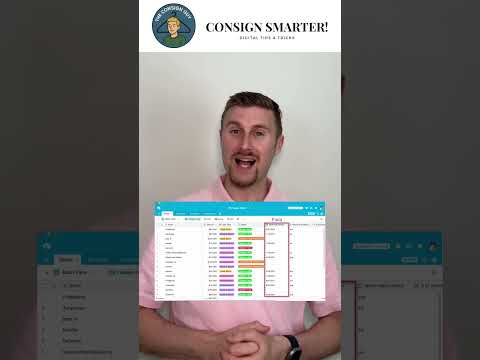
Track Every Consigned Item with Airtable (No POS Required!!)
Use Airtable to record each item’s consignor, intake date, price and status, and make aged inventory easier to find.
Video and shop exercise